A range of facilities and doors can benefit from being held open during normal use. One compliant option for fire doors is to install a new electromagnetic door closer. However, if your project or premises already have overhead door closers installed and you’re looking for a quick, retrofit option, a magnetic door holder is a great choice.
With models for different fire door ratings and to suit different door closer sizes, there is a wealth of choice. They all release the door when the fire alarm is activated, preventing the spread of fire and smoke through effective compartmentation, but how do you know which product best suits your facilities?
Here we’ll take you through the main considerations when selecting a suitable hold open device and answer some commonly asked questions.
What to Consider When Choosing a Fire Door Retainer
When faced with very similar-looking products, other than obvious variations like finish, there are many differentiators between models of door holders.
These are the main differences to watch out for:
Voltage - 24VDC, 230VAC, 24V AC/DC are common models. Check product-specific details for differences in current draw.
Power options – hard wired or battery-powered retainers are available, with battery-powered models including a low battery warning.
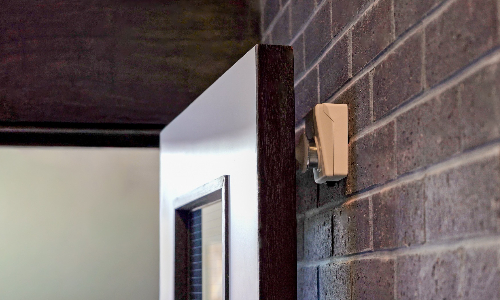
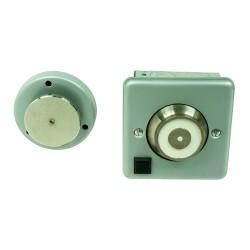
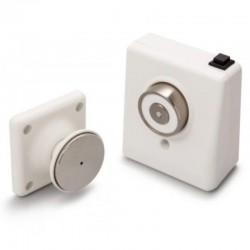
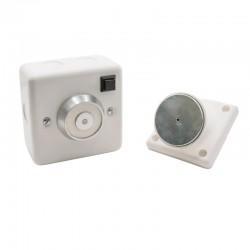
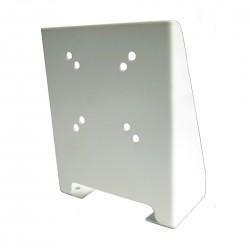
Mounting - on-door mounting like the Dorgard, SmartSound, and DoorSense units, floor mounting, or surface or flush mounting to a wall.
Mounting position - the power size of the door closer will impact how far away from the hinges a door holder should be installed. The lower the door closer power size, the closer to the hinges the holder can be fitted:
Hold open angle - door-mounted units can hold a door open at any chosen angle, whereas most models are more restrictive, as the magnet is mounted to a wall, so the door can only be held open at one fixed angle.
Holding force - magnet holding forces of retainers vary, and are often 200N, 400N, or up to 500N. Select a heavier-duty magnet for heavier doors.
Test methods - door retainers can feature a test button, be manually tested, or have a separate manual release switch installed nearby.
Test evidence - various standards apply to fire door holders. All will be tested to BS EN 1155 and EN61000-6, be UKCA or CE marked, and some will also have a fire test to BS EN 1634. However, units can differ with testing to BS 7273-4 as different categories can apply - A, B, C. There may also be a difference in third-party testing.
General specifications - variations can be found in temperature range, IP rating, cable size, and cable entry points, so check model-specific details to ensure they meet the requirements of your project.
Door type - make sure your chosen magnetic door holder suits the weight and width of the door leaf it’s being installed on.
Fire Door Holder Comparison
This chart compares our best-selling door holders so you can see at a glance which is going to be the best choice for the fire doors in your facility.
Magnetic Door Holder FAQs
Q: Are fire door holders legal?
A: Yes. When tested to BS EN 1155, CE marked, and fitted in accordance with the manufacturer's fitting instructions, they are legal to install on fire rated doors.
Q: Do magnetic fire door holders need to be manually released?
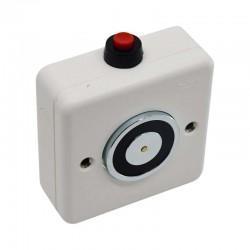
A: No, when a fire alarm activates, power to the electromagnetic door holder is cut either through a fire alarm interface or directly from the fire alarm panel. As the holder relies on constant power, it de-energises when the supply is interrupted, releasing the fire door so it can close automatically and help contain smoke and fire.
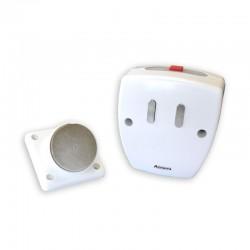
Acoustic door holders work differently, as they are not wired into the alarm system. Instead, they monitor sound levels and release the door when an alarm signal reaches a preset decibel level.
Q: Can door holders be activated from the sounder circuit?
A: Acoustic door holders cannot be activated directly from the sounder circuit. They are self-contained devices that release when they detect the fire alarm sound, during a power failure, by manual operation, or in response to prolonged loud noise.
In contrast, hard-wired door holders are released by the fire alarm system itself, and the fire alarm interface may be connected to the sounder circuit depending on the type of system installed.
Q: How does a plunger door holder work?
A: They are easily operated by foot. Open the door so it’s in line with the keeper plate on the floor, then depress the plunger using your foot.
Q: What happens when the battery runs out on the door retainer?
A: If the low battery alert is missed and the batteries run flat, the door holder will no longer hold the door open. The plunger won’t stay in the engaged position. Easily replace the batteries for the retainer to hold the door open once again.
Q: How often should I test a fire door retainer?
A: Test fire door retainers weekly. Do this as part of your fire system testing procedures.
Q: Why isn’t my door retainer holding?
A: There could be many reasons, but start by checking the following:
For hard wired models, check:
The surface of the magnet and the contact plate are clean, free of debris, and properly aligned to ensure full magnetism.
Is the magnet receiving the correct voltage? Hardwired door holders are fail-safe, so they require constant power.
An overloaded power supply could cause insufficient holding strength.
The fire alarm relay could be incorrectly programmed, preventing the door holder from being released when required.
For battery-powered door holders, check:
Do the batteries need replacing? Low power will mean the door retainer will not hold the door open.
Check that the batteries are installed correctly and are making proper contact with the terminals.
Make sure the battery type matches the manufacturer’s recommendations. Using the wrong type can reduce holding strength.
Once you’ve chosen a suitable product to hold the door open, it’s on to installation. And, whilst each model has its nuances, you can watch our video on how to install the Geofire Doormouse door holder for guidance.
How to Install a GeoFire Electromagnetic Door Holder
Fire Door Retainers for Compliant Hold Open
Magnetic door retainers are a compliant solution for holding open fire doors, negating the need to have them wedged open during busy times of the day. By fitting the right model for your door, in the event of a fire, compartmentation will be ensured, and doors will be closed automatically by the fire door closer.
Select a model with a suitable voltage that can be fitted to the door, wall, or floor and suits the fire rating, weight, and width of your fire door. And, for any help with installation or troubleshooting, our expert team is here to guide you.



.jpg)
%20(1).jpg)





Comments